
Evidence summary: Strong evidence for lowering triglycerides; mixed evidence for preventing cardiovascular events with ordinary supplements. Prescription EPA has demonstrated benefits in selected patients.
Reading time: Approximately 9 minutes
Introduction
Do omega-3 supplements protect your heart? The answer depends on the product, the dose and your existing cardiovascular risk.
Research supports the ability of omega-3 fatty acids to lower triglycerides, a type of fat in the blood. However, this does not automatically mean that taking a fish oil capsule will prevent a heart attack or stroke.
Large trials have produced different results. Some benefits have been demonstrated with a specific prescription EPA medicine, while trials of combined EPA and DHA have often found no significant reduction in their main cardiovascular outcome. See the REDUCE-IT trial and STRENGTH trial.
This guide explains what those findings mean when considering omega-3 for heart health.
What Are Omega-3 Fatty Acids?
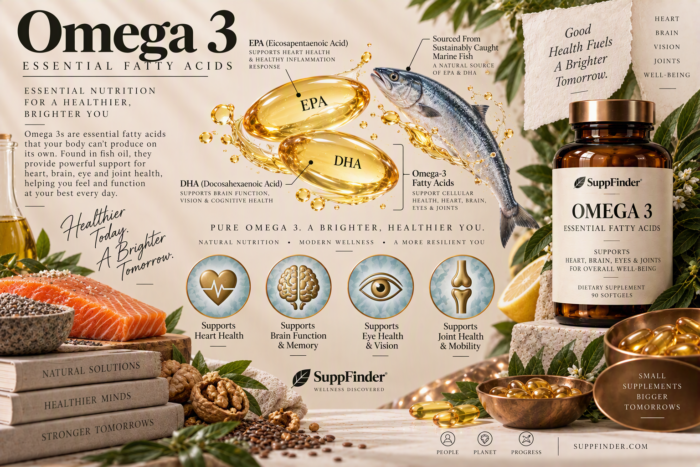
Three commonly discussed omega-3 fatty acids are:
- EPA — eicosapentaenoic acid: Found in oily fish and some algae-derived products.
- DHA — docosahexaenoic acid: Found in oily fish and algae.
- ALA — alpha-linolenic acid: Found in plant foods such as walnuts, flaxseed and chia seeds.
The body can convert some ALA into EPA and DHA, but conversion is limited. Plant sources of ALA therefore do not provide an equivalent amount of EPA and DHA.
Fish oil supplements commonly contain both EPA and DHA. Algal products vary: some supply mainly DHA, while others contain both. Check the individual label. The NIH omega-3 factsheet explains these differences.
Evidence Rating
A single “strong” rating for heart health would hide meaningful differences between outcomes.
| Outcome | Evidence assessment | What it means |
| Lowering triglycerides | Strong | Omega-3 can lower triglycerides, with effects influenced by dose and starting levels. |
| Preventing cardiovascular events with ordinary fish oil supplements | Mixed; routine use is not supported by UK guidance | Some analyses find modest benefits, but major trials have not consistently demonstrated protection. |
| Reducing cardiovascular events with prescription icosapent ethyl | Strong within a defined patient group | Benefits were demonstrated in selected patients taking statins who had raised triglycerides and additional cardiovascular risk. |
| Preventing stroke with ordinary supplements | No consistent demonstrated benefit | Fish oil should not be presented as an established stroke-prevention treatment. |
These are editorial summaries of the research discussed below, rather than a formal GRADE assessment.
Potential Benefit #1: Lowering Triglycerides
Triglyceride reduction is one of the clearest findings in omega-3 research.
A 2020 Cochrane systematic review found that increasing long-chain omega-3 intake reduced triglycerides by approximately 15% on average, with a dose-dependent effect.
However, an improvement in a blood test is different from a demonstrated reduction in heart attacks, strokes or deaths.
Practical meaning: If your triglycerides are raised, discuss treatment with your GP. The appropriate approach depends on your blood results, other conditions and overall cardiovascular risk.
Potential Benefit #2: Reducing Cardiovascular Events in Selected Patients
The strongest positive trial result comes from a particular prescription product.
The REDUCE-IT trial enrolled 8,179 patients receiving statins who had raised triglycerides and either established cardiovascular disease or diabetes with additional risk factors.
Participants received 4 g daily of icosapent ethyl, a purified EPA medicine, or placebo.
Over a median of 4.9 years, the main combined cardiovascular outcome occurred in:
- 17.2% of patients receiving icosapent ethyl.
- 22.0% of patients receiving placebo.
That is an absolute difference of 4.8 percentage points, alongside an approximately 25% relative reduction in the time-to-event analysis.
The combined outcome included cardiovascular death, non-fatal heart attack, non-fatal stroke, coronary revascularisation and hospitalisation for unstable angina.
Practical meaning: This supports a specific treatment for a defined patient group. It does not establish equivalent benefits for ordinary shop-bought fish oil.
Potential Benefit #3: Preventing Heart Attacks With Ordinary Supplements
The evidence is less straightforward for people taking supplements for general prevention.
The VITAL trial, involving 25,871 adults, found that marine omega-3 supplementation did not significantly reduce the main combined outcome of heart attack, stroke or cardiovascular death over a median of 5.3 years.
Heart attacks were reduced in a secondary analysis. That finding is relevant, but it should be interpreted alongside the main result rather than used alone to claim broad cardiovascular protection.
Practical meaning: Ordinary omega-3 supplements cannot be confidently recommended to everyone as a way to prevent a first heart attack or stroke.
Why Do Studies Produce Different Results?
“Omega-3” describes several products and treatment approaches.
In the STRENGTH trial, 13,078 patients at high cardiovascular risk received either 4 g daily of a combined EPA/DHA formulation or corn oil.
The trial found no significant improvement in its main combined cardiovascular outcome and stopped early.
Meanwhile, a 2021 meta-analysis by Khan and colleagues, covering 38 randomised trials and 149,051 participants, found reductions in several cardiovascular outcomes overall. Benefits were more pronounced in EPA-only trials than in trials using EPA and DHA together.
These findings require careful interpretation. Trials differ in their formulations, doses, participants, background treatment and comparison groups. Comparing separate trials cannot prove that DHA cancels out EPA’s benefits.
The useful question is whether a particular product has demonstrated a particular benefit in people similar to you.
Fish Oil Supplements vs Prescription EPA
| Feature | Ordinary fish oil supplement | Prescription icosapent ethyl |
| Contents | Usually EPA and DHA, in varying amounts | A specific purified EPA medicine |
| Main role | Supplementing dietary intake | Treatment for eligible patients |
| Dose | Depends on the product | Prescribed by a clinician |
| Cardiovascular evidence | Mixed across products and populations | Positive trial evidence in a defined patient group |
| Interchangeable? | Cannot be assumed equivalent to prescription EPA | Should be used according to prescribing guidance |
In the UK, NICE guidance advises against offering omega-3 fatty acid compounds to prevent cardiovascular disease, with an exception for icosapent ethyl when used under its specific eligibility guidance.
Dosage and Practical Considerations
Is There a Recommended Dose for Heart Disease Prevention?
There is no established over-the-counter fish oil dose that everyone should take to prevent cardiovascular disease. UK guidance does not recommend routine omega-3 treatment for this purpose, apart from the specific prescription exception described above. See NICE recommendations.
High doses used in clinical trials are treatment doses, rather than a target for self-supplementation.
Check EPA and DHA, Not Just “Fish Oil”
A capsule labelled “1,000 mg fish oil” does not necessarily contain 1,000 mg of EPA and DHA.
For example, a typical formulation may contain 180 mg EPA and 120 mg DHA: 300 mg combined EPA and DHA. Formulations vary substantially, as explained in the NIH factsheet.
Check the amount per daily serving, including how many capsules that serving requires.
What About Food Sources?
The NHS recommends at least two portions of fish weekly, including one portion of oily fish, as part of a balanced diet.
Examples include salmon, sardines, mackerel and herring. Different limits apply to some groups, including during pregnancy.
Dietary fish guidance and evidence about supplement capsules answer different questions. One should not be used as proof of the other.
Safety Considerations
Common Side Effects
Omega-3 supplements can cause unpleasant taste, heartburn, nausea, digestive discomfort or diarrhoea. These are usually mild. See the NIH safety information.
Atrial Fibrillation
Atrial fibrillation is a heart rhythm disorder that can increase stroke risk.
A 2021 systematic review and meta-analysis by Gencer and colleagues found an increased risk of atrial fibrillation across cardiovascular outcome trials of marine omega-3 supplementation, with a stronger signal at higher doses.
This is a reason to discuss high-dose use with a clinician, particularly if you have a history of atrial fibrillation or another rhythm problem.
Bleeding and Medication Interactions
A 2024 meta-analysis of 11 randomised trials involving 120,643 participants found no statistically significant increase in bleeding overall.
However, high-dose purified EPA was associated with a small absolute increase in bleeding risk, approximately 0.6 percentage points.
If you take anticoagulants or antiplatelet medicines, check with your pharmacist or prescriber before starting a supplement. Do not change prescribed medication yourself.
Pregnancy and Cod Liver Oil
Cod liver oil differs from ordinary fish oil because it also contains vitamins, including vitamin A.
The NHS advises avoiding supplements containing vitamin A during pregnancy, including fish liver oils.
Final Verdict
Omega-3 has a clear role in triglyceride lowering, but its cardiovascular benefits depend on the formulation and the people taking it.
Prescription icosapent ethyl has reduced cardiovascular events in selected patients receiving statins. Ordinary fish oil supplements have not consistently produced comparable benefits. The contrast between REDUCE-IT and STRENGTH illustrates why those products should not be treated as interchangeable.
For general heart health, follow dietary guidance and address your individual risk factors with your healthcare team. If you have raised triglycerides or existing cardiovascular disease, ask whether a specific treatment is appropriate.
SuppFinder assessment: Strong evidence for triglyceride lowering; mixed evidence for general cardiovascular prevention with ordinary supplements; demonstrated benefit for prescription EPA in eligible patients.
Frequently Asked Questions
Does Fish Oil Prevent Heart Attacks?
It has not been consistently shown to prevent cardiovascular events across the general population. The VITAL trial found fewer heart attacks in a secondary analysis, but no significant reduction in its main combined cardiovascular outcome.
Is More Omega-3 Better?
Higher doses are not automatically more beneficial. They can increase triglyceride lowering, but cardiovascular trials have also identified concerns about atrial fibrillation. See the Cochrane review and Gencer meta-analysis.
Can Fish Oil Replace a Statin?
Fish oil should not replace prescribed statin treatment. The positive REDUCE-IT trial evaluated prescription EPA alongside statins.
Is Algal Omega-3 Equivalent to Fish Oil for Heart Disease Prevention?
Algal supplements can provide DHA and sometimes EPA, but their nutrient content does not establish that they prevent cardiovascular events. Check the formulation, and avoid assuming that findings from prescription EPA trials apply to an algal supplement. See the NIH overview of omega-3 products.
References
Peer-Reviewed Research
1. Abdelhamid AS, et al. (2020). Omega-3 fatty acids for the primary and secondary prevention of cardiovascular disease. Cochrane Database of Systematic Reviews. CD003177.
2. Manson JE, et al. (2019). Marine n-3 Fatty Acids and Prevention of Cardiovascular Disease and Cancer. New England Journal of Medicine, 380:23–32.
3. Bhatt DL, et al. (2019). Cardiovascular Risk Reduction with Icosapent Ethyl for Hypertriglyceridemia. New England Journal of Medicine, 380:11–22.
4. Nicholls SJ, et al. (2020). Effect of High-Dose Omega-3 Fatty Acids vs Corn Oil on Major Adverse Cardiovascular Events in Patients at High Cardiovascular Risk: The STRENGTH Randomized Clinical Trial. JAMA, 324:2268–2280.
5. Khan SU, et al. (2021). Effect of omega-3 fatty acids on cardiovascular outcomes: A systematic review and meta-analysis. eClinicalMedicine, 38:100997.
6. Gencer B, et al. (2021). Effect of Long-Term Marine Omega-3 Fatty Acids Supplementation on the Risk of Atrial Fibrillation in Randomized Controlled Trials of Cardiovascular Outcomes: A Systematic Review and Meta-Analysis. Circulation, 144:1981–1990.
7. Javaid M, et al. (2024). Bleeding Risk in Patients Receiving Omega-3 Polyunsaturated Fatty Acids: A Systematic Review and Meta-Analysis of Randomized Clinical Trials. Journal of the American Heart Association, 13:e032390.
Guidance and Background Information
This article provides general educational information and is not a substitute for individual medical advice, diagnosis or treatment.