
Evidence summary: Human evidence is preliminary. Small studies provide signals on selected cognitive tasks, but do not establish general memory enhancement, dementia prevention or dependable stress relief.
Reading time: Approximately 4 minutes
Introduction
Lion’s mane, or Hericium erinaceus, is an edible mushroom sold as a cognitive supplement. Much of its reputation comes from laboratory and animal research into neurotrophic pathways.
Those mechanisms are interesting, but they do not establish that a capsule improves everyday thinking or protects the human brain as it ages. Controlled human findings deserve separate attention.
This guide explains the main signal and why the current evidence calls for measured expectations.
What Is Lion’s Mane
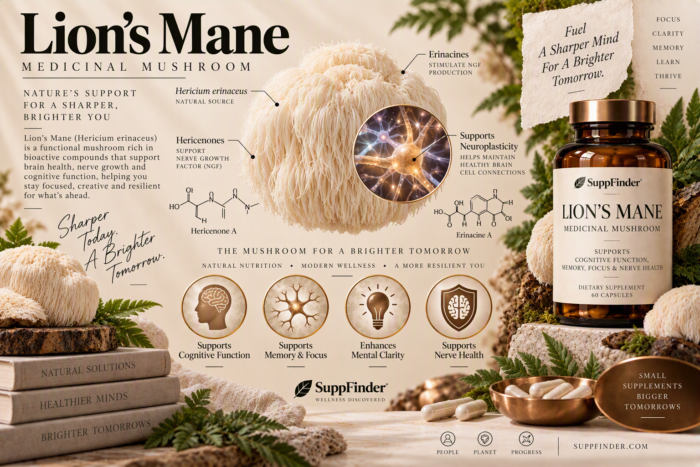
Supplements can contain fruiting-body material, mycelium or extracts. Products vary in preparation and constituents, including compounds described as hericenones and erinacines.
The presence of a named compound or a high extraction ratio does not itself establish a clinical benefit. A product should be compared with the preparation tested, not simply with the general mushroom name.
Evidence Rating
| Proposed benefit | Assessment | Main limitation |
| Selected cognitive task performance | Preliminary | Small studies and mixed outcomes |
| Everyday memory enhancement | Uncertain | Laboratory tasks do not establish meaningful daily benefit |
| Stress or mood improvement | Preliminary | Some findings are trends rather than clear differences |
| Dementia prevention or nerve regeneration | Not established | Human clinical evidence is insufficient |
These are editorial summaries, not formal GRADE ratings.
What the Human Trial Found
A 2023 pilot trial tested 1.8 g daily in 41 healthy young adults, assessing a single dose and 28 days of use.
Participants performed faster on a Stroop task after an acute dose. A stress finding after repeated use was a statistical trend, rather than a clearly significant result. Null and some negative findings also occurred.
The sample was small and multiple outcomes were tested. A positive result on one task should not be described as broad proof of better cognition, and the study does not establish prevention of age-related decline.
A 2025 acute trial found no significant improvement in composite global cognition or mood, despite an individual pegboard-test finding. This is an important counterweight to claims of broad cognitive enhancement.
Potential Benefit One Attention or Processing Measures
The pilot result provides a reason to test specific cognitive effects in larger trials. It cannot tell every reader whether they will notice better concentration at work or study.
The clinically useful question is whether an effect is repeatable, meaningful and relevant to the person taking the product. Faster performance on one test is only part of that assessment.
Potential Benefit Two Stress and Mood
Preliminary stress findings should retain their uncertainty. A result close to a conventional significance threshold is not a confirmed benefit simply because it is described as “promising”.
Lion’s mane should not be presented as a treatment for anxiety or depression, and persistent symptoms deserve established assessment and care.
What Laboratory Research Cannot Prove
Changes in nerve-growth pathways in cells or animals do not establish nerve regrowth in people, prevention of dementia or reversal of brain ageing.
These are different claims requiring different clinical trials. A review that combines preclinical and human studies should make those evidence types visible rather than count them as equivalent support.
Dosage and Product Choice
There is no established universal cognitive dose. The 1.8 g amount above describes the preparation tested in one pilot trial; it should not be transferred directly to every extract.
Check species, material, preparation, daily amount and whether the label provides transparent information. “Fruiting body only” or “high beta-glucan” may describe a product, but does not by itself prove superior memory outcomes.
Safety Considerations
Small, short trials provide limited information about long-term safety, uncommon reactions and interactions. Avoid use if allergic to the product or its source, and stop for symptoms of an allergic reaction.
Pregnancy, breastfeeding, long-term conditions and regular medicines warrant professional advice. Absence of a well-documented interaction is not proof that a combination has been tested.
Persistent or worsening memory symptoms should be assessed rather than managed by progressively adding cognitive supplements.
Final Verdict
Lion’s mane is an early research candidate, not an established brain-health essential. A careful buying decision recognises the small human evidence base and avoids treating mechanistic interest as a guarantee of everyday benefit.
Frequently Asked Questions
Does It Regrow Brain Cells
Human clinical evidence does not establish that taking a supplement produces the brain-regeneration benefits advertised online.
Is a Concentrated Extract Better Than Powder
Not necessarily. The comparison needs relevant trials of the actual preparations, rather than extraction ratios alone.
References
Peer-Reviewed Research
This article provides general educational information and is not a substitute for individual medical advice, diagnosis or treatment.