
Evidence summary: Vitamin C has established nutritional roles. Regular supplementation may modestly shorten colds, but it does not generally prevent them, and starting after symptoms begin has not shown consistent benefit.
Reading time: Approximately 4 minutes
Introduction
Vitamin C is essential for normal health and is commonly sold for immunity, skin and recovery. Those uses need careful distinction: maintaining adequate intake is different from demonstrating extra benefit from high-dose tablets.
Cold research is especially easy to oversimplify. Studies of regular supplementation do not answer the same question as taking a large dose after a sore throat begins.
This guide explains what the evidence supports and how to judge whether supplementation is necessary.
What Does Vitamin C Do
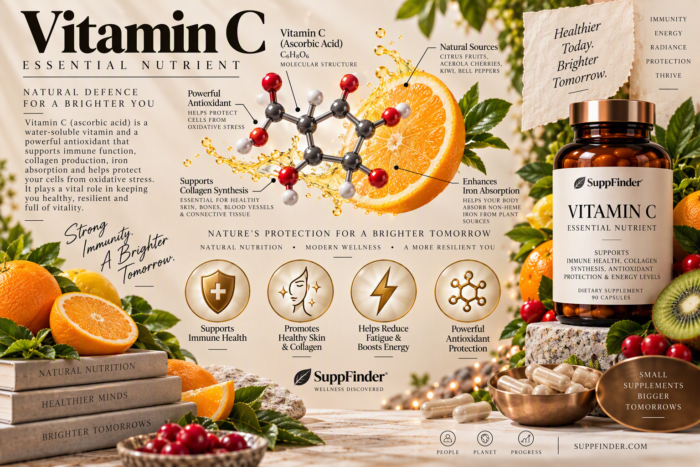
Vitamin C contributes to collagen synthesis and normal tissue function, and helps absorption of non-haem iron. Fruit and vegetables are important dietary sources.
The NHS guidance lists an adult requirement of 40 mg daily for ages 19–64. Most people can meet this through a varied diet, so a gram-dose supplement should not be confused with a normal dietary requirement.
Evidence Rating
| Application | Assessment | Important qualification |
| Preventing deficiency | Established | Adequate intake matters |
| Preventing ordinary colds | Little general benefit | Exceptions in certain intense-exercise settings do not apply to everyone |
| Shortening colds with regular use | Modest benefit | Average changes are relatively small |
| Starting treatment after symptoms | Inconsistent | Not equivalent to regular supplementation studies |
| Extra skin or wound benefits with adequate intake | Not established generally | Normal nutrient function is not proof of enhancement |
These are editorial summaries, not formal GRADE ratings.
Potential Benefit One Meeting Nutritional Needs
Vitamin C deficiency can cause scurvy, so adequate intake is important. Supplements can help where diet is insufficient, but they are not the only way to meet that need.
Citrus fruit, peppers, berries, broccoli and other vegetables can contribute. The best approach depends on the overall diet and any clinical reason for a shortfall.
Potential Benefit Two Cold Duration
The Cochrane review found that regular vitamin C supplementation modestly shortened cold duration. In adults, the average reduction was about 8%.
That is not the same as preventing a cold or guaranteeing rapid recovery. An average percentage change may translate into a relatively small difference for an ordinary episode.
Does It Prevent Colds
The same review found no meaningful general reduction in cold incidence in the ordinary community population. Some highly physically stressed groups differed, but those settings should not be used to promise equivalent prevention to everyone.
Normal immune function requires nutrients; this does not mean that extra amounts keep enhancing immunity once needs are met.
What About Starting When Symptoms Begin
Evidence for beginning vitamin C only after symptoms start has not shown consistent benefit. Marketing often cites regular-use studies while recommending a different treatment approach.
For a fair comparison, the timing, dose and population in the evidence should match the proposed use.
Skin Collagen and Antioxidant Claims
Vitamin C is required for normal collagen formation, but this does not establish that high-dose supplements improve skin appearance in everyone with adequate intake.
Similarly, antioxidant activity is not proof of fewer diseases or longer life. The relevant question is whether a controlled study demonstrated the claimed outcome, not simply whether a mechanism sounds beneficial.
Dosage and Safety
There is no need to equate a high label dose with better results. NHS advice notes that large amounts, particularly above 1,000 mg daily, can cause abdominal pain, diarrhoea and wind.
People with kidney-stone risk, iron-overload disorders or complex medical treatment should check suitability before using high doses. The NIH factsheet discusses additional safety considerations.
Count vitamin C in combination cold products and other supplements. Taking several products can increase intake without improving the evidence for benefit.
Final Verdict
Vitamin C is nutritionally important, but high-dose supplementation is not a universal immunity strategy. Regular use may modestly shorten colds; ordinary prevention and treatment after symptom onset are less convincing. A varied diet remains the simplest source for many adults.
Frequently Asked Questions
Does More Vitamin C Mean Stronger Immunity
Not automatically. Normal immune function and enhancement beyond adequate intake are different claims.
Is a Gram a Day Necessary
No. That is far above the ordinary adult dietary requirement and is not established as necessary for everyone.
References
Peer-Reviewed Research
Guidance and Background Information
This article provides general educational information and is not a substitute for individual medical advice, diagnosis or treatment.